

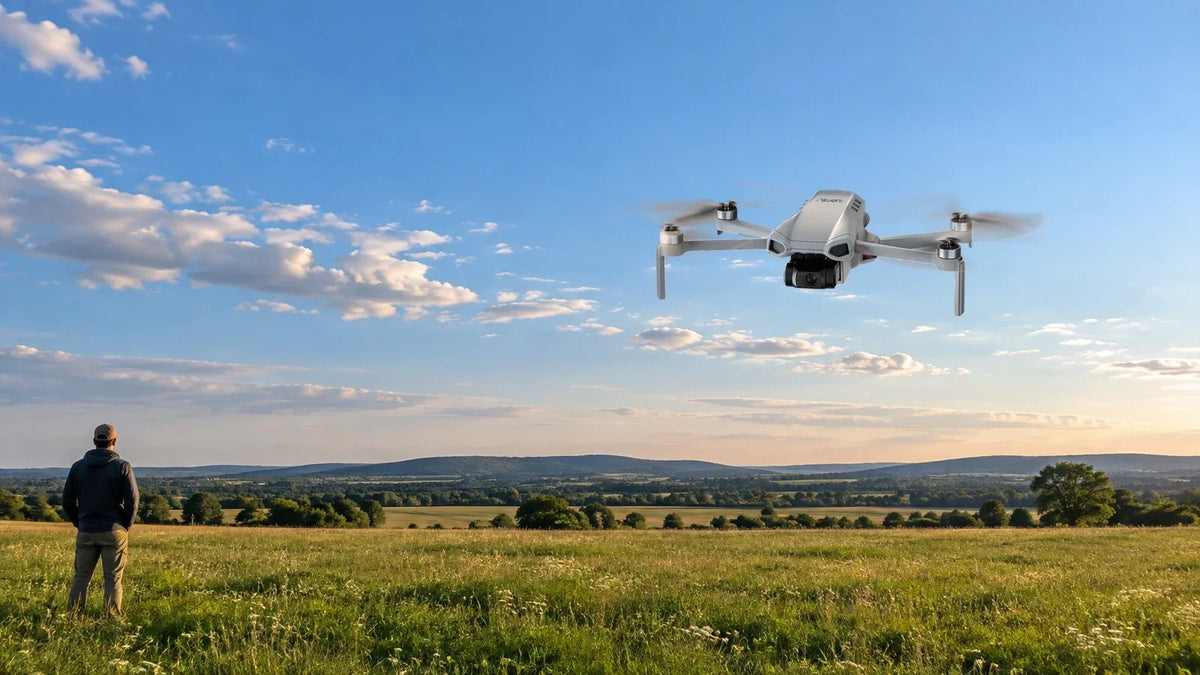
A specification tells you something about an aircraft. It does not tell you what is permitted at the place you want to fly.
Before a U.S. recreational flight, separate three questions: How high may I fly here? Can I keep the aircraft in sight? Have I completed the requirements for this flight?
Start with the airspace
For ordinary recreational flying in Class G uncontrolled airspace, fly at or below 400 feet above ground level. Controlled airspace requires prior authorization, and the authorized altitude may be lower. Restricted areas, temporary restrictions and local takeoff or landing rules also matter.
Do not use a displayed height relative to takeoff as your only reference when the ground below changes. Plan conservatively around terrain and give way to other aircraft.
Range is not a distance target
A clear live video feed does not replace visual line of sight. Keep the aircraft visible so that you can understand its position and avoid other traffic. Leave a battery reserve for the return, including the possibility of a headwind.
Weight changes some requirements
U.S. recreational pilots must complete TRUST and carry proof. Aircraft under 250 g can qualify for the recreational registration exemption; adding accessories can change the takeoff weight. Aircraft that require registration, or are registered, generally need Remote ID compliance, subject to applicable exceptions.
Flights outside the recreational exception have different requirements. Check the current rules for your purpose and location before taking off.
Choose for the flights you can actually make
Veyra is the light-packing choice at 247 g. It offers 35 MP photos, 4K video, up to 38 minutes per battery and a maximum advertised transmission range of 5.5 miles. Its weight can be relevant to recreational registration, but it does not create a blanket exemption from flight rules.
Falcon suits relaxed weekend flying. Its 562 g aircraft offers 25 MP photos, up to 35 minutes per battery and a maximum advertised transmission range of 3 miles.
Specter is the camera-focused option: 705 g, 48 MP photos, 4K video, up to 53 minutes per battery and a maximum advertised transmission range of 9 miles.
All three include a three-axis mechanical gimbal. For a first outing, a simple, nearby camera move may tell your story better than a high or distant flight.
A useful plan fits on a short checklist
Choose your location, verify the airspace and site rules, check the weather, identify a clear landing area, and decide what you will do if conditions change. Only then choose the shot.
U.S. recreational guidance reviewed September 18, 2026. Rules can change; verify current requirements before flying. Product endurance and transmission figures are advertised maxima and vary with conditions. This article does not cover every operation or jurisdiction.
Share:
Is Specter the Right Drone for Your Next Step?
Why a Three-Axis Gimbal Matters More Than Another Big Camera Number